- Caption
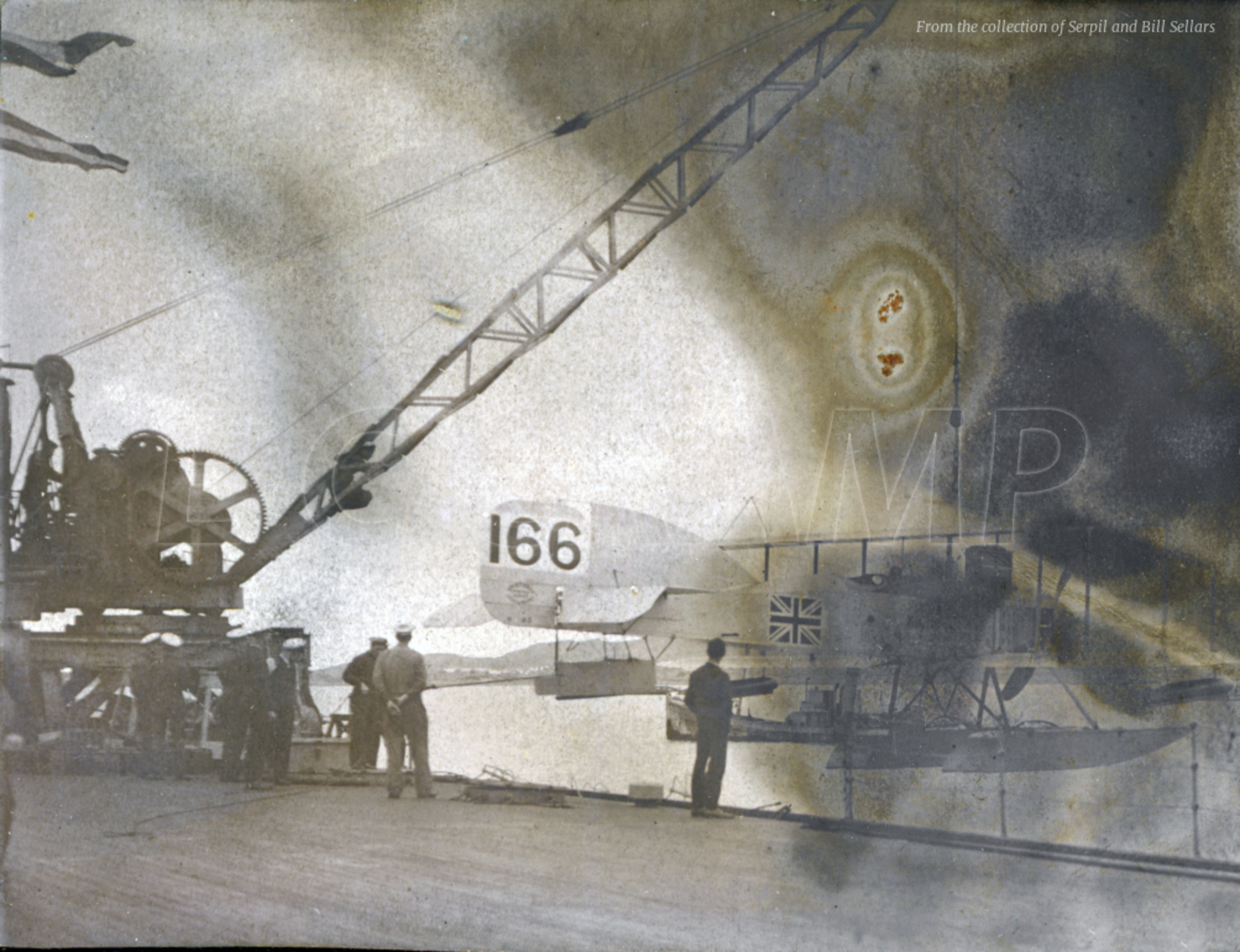
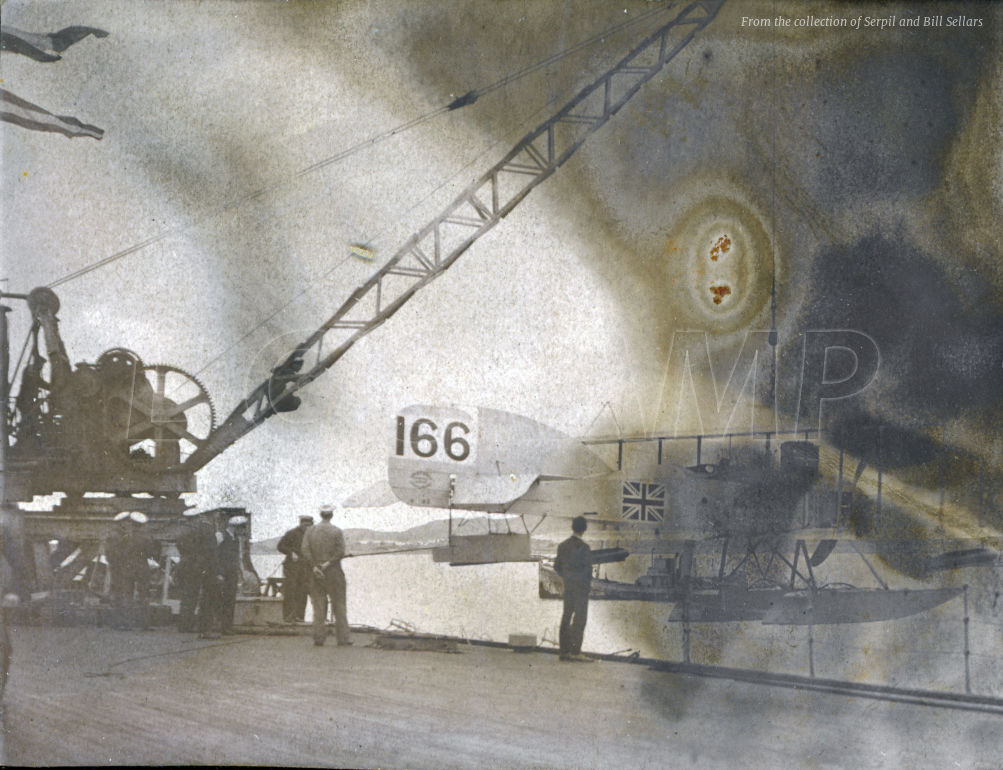
- Lowering Seaplane to sea, Dardanelles / [reverse] being lowered from deck
- Catalogue number
- CR22
- Notes
Short seaplane numbered 166.
SHORT TYPE C TRACTOR BIPLANE SEAPLANE (Later 166 TYPE) ordered 1.14 under Cont No C.P.37385/14, built Rochester & numbered 161 to 166. (200-hp Canton-Unné)
166 (c/n S.95). Deld Grain in tow 26.8.15; Shipped to Dardanelles in SS Norman Prince 9.15; arr HMS Ark Royal 10.15; Tested after erection 10.10.15; EF [engine failure], FL [force landed], drifted 4 hrs then picked up by HMS Euryalus’ picket boat 5.11.15 (Lt CW Pulford & Lt LH Strain); Flown again 16.11.15; Stavros 29.2.16; Briefly in HMS Roberts 29.5.16; Conv landplane at Thasos 1916; Tested HMS Ark Royal 5.10.16 (seaplane); HMS Empress (ex Mudros) 6.10.16; Mudros 28.12.16; NFT
— Ray Sturtivant and Gordon Page, Royal Navy aircraft serials and units 1911 to 1919 (Air-Britain 1992)
The type is described in this article:
The half-dozen machines ordered from Short Brothers were numbered 161-166, and the aircraft was officially known as the Short seaplane, Admiralty Type 166. No. 161 bore the works number S.90, and some references call the type the Short S.90.
The Short 166 bore a strong resemblance to the Short No. 136 but was a slightly larger aircraft and differed in several details. It was intended from the beginning to be a torpedo-carrier, and the float cross-bars were suitably arched to accommodate the missile. The two-bay wings could, of course, be folded, but the extensions of the upper wings were cable-braced and there were king-post structures above the outer interplane struts. The one-piece, single-acting ailerons lay wholly outboard of those struts; they were of broad chord and had compound inverse taper. The tail unit was typical of Short design, embodying a balanced rudder. Twin wooden pontoon floats composed the main undercarriage; the tail float had a water rudder, and a stabilizing float was fitted under each lower wing.
The Short 166 was designed for use from Ark Royal, and when the carrier was at Salonika, whence it had gone on November 7, 1915, she had five of the original six Short 166s on board: one of the seaplanes was No. 166 itself. There is no positive record that any of the Short 166s ever used a torpedo operationally, but they were used as reconnaissance aircraft, acted as spotters for Allied ships bombarding Turkish positions, and maintained extensive submarine patrols. In this work they operated from Aliki Bay. One of the Ark Royal’s Short 166s was placed on board the monitor Roberts in September 1915, and spotted for the ship’s guns against batteries on the Asiatic coast opposite the Rabbit Islands. Another Short was lent to the monitor Raglan in October and, operating in the Gulf of Xeros, spotted not only for Raglan but for the cruiser Theseus also.
- File
- Download Research only – request permission to reproduce