- Caption
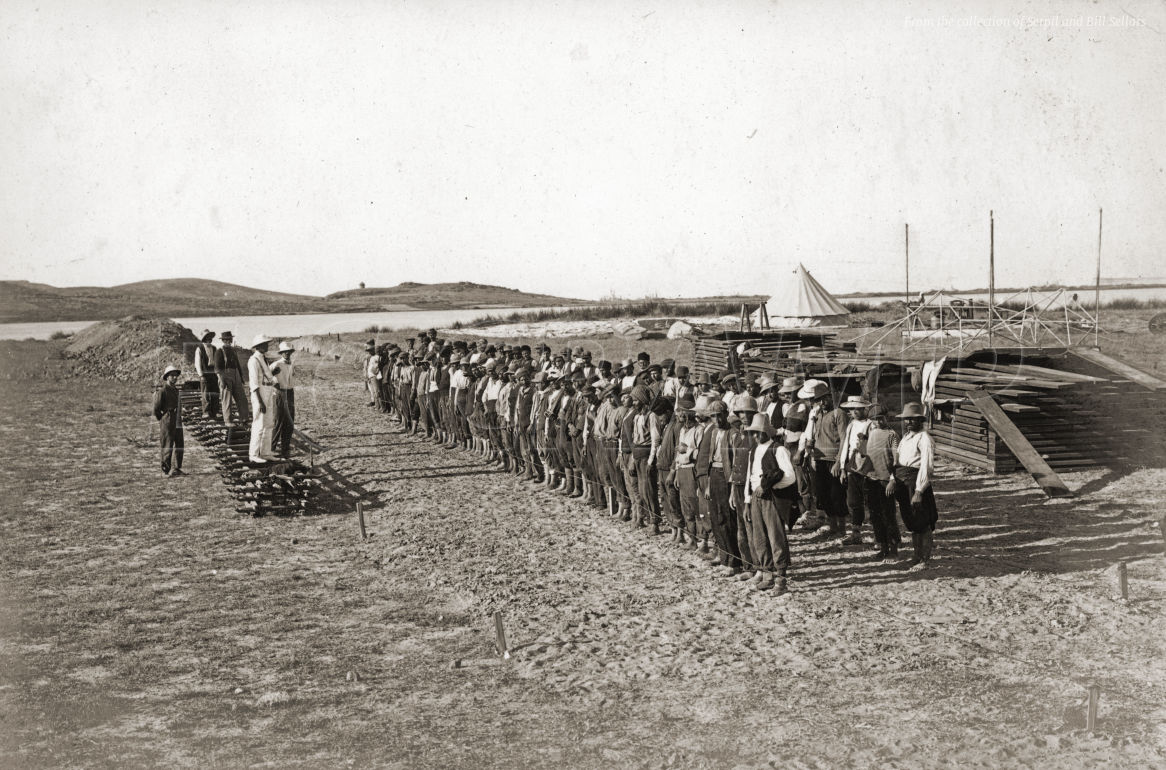
- Greek “working”? party, Imbros / [reverse] Base
- Catalogue number
- CR04
- Place
- Imbros
- Notes
It is likely the working party was engaged on laying tracks for a Decauville light rail line.
The foreman or official addressing the workers, dressed in white, is standing on a stack of Decauville pre-assembled sections of track, ready to be laid, while close to the shore can been seen a pile of spoil, earth excavated from where the line terminated at the coast.
Just in front of the first rank of workmen can be seen a line of string, probably marking the line of the track to be laid.
Across the salt lake there is a windmill. It was this windmill that gave its name to Windmill Camp when 2 Wing RNAS established its aerodrome to the right of the hill.
This photo could have been taken in the second or third week of May, as a shore base was being set up on Imbros. Ark Royal’s log notes that on 9 May the ship arrived at Kephalo Bay, having been cruising off Kabatepe, to the south of the Anzac beachhead.
On 10 through to 17 May, with the exception of 13 May, survey parties from Ark Royal went ashore at Imbros, while on 18 and 19 May a survey and working party were recorded as going ashore.
By 20 May, as work continued ashore, the crew were reported in the log as, “preparing gear for landing party”, ahead of the establishing of the seaplane base.
The inverted commas and question mark around the word working in the hand written caption to the photo suggests Edgar did not think the Royal Navy was getting value for money from its Greek labourers.
Another to mention the light rail and the Greek workers was Lieutenant Harry Strain, an observer with the Royal Naval Air Service who served on the Ark Royal during the campaign.
In his diary entry for June 20, Strain said the railway, which would link the lagoon on Imbros with the sea and allow seaplanes to be transferred from one to the other, was being laid by 75 Greek labourers.
“Most of our Greeks are now cutting and levelling it; it is only 300 yards long and gradients will be 1 in 60 to 1 in 90. We got 25 local Greeks and 50 refugees from Tenedos.”
A few days later, on June 26, Strain again mentioned the Decauville, and the progress in developing the Imbros base.
“Now we have tents up here, the railway progresses and we are going a good deal of flying.”
(From the diary of Harry Strain, held by the Royal Air Force Museum, London, transcribed by Bernard de Broglio)
- File
- Download Research only – request permission to reproduce
